
Custom Website or Template for Your Business?
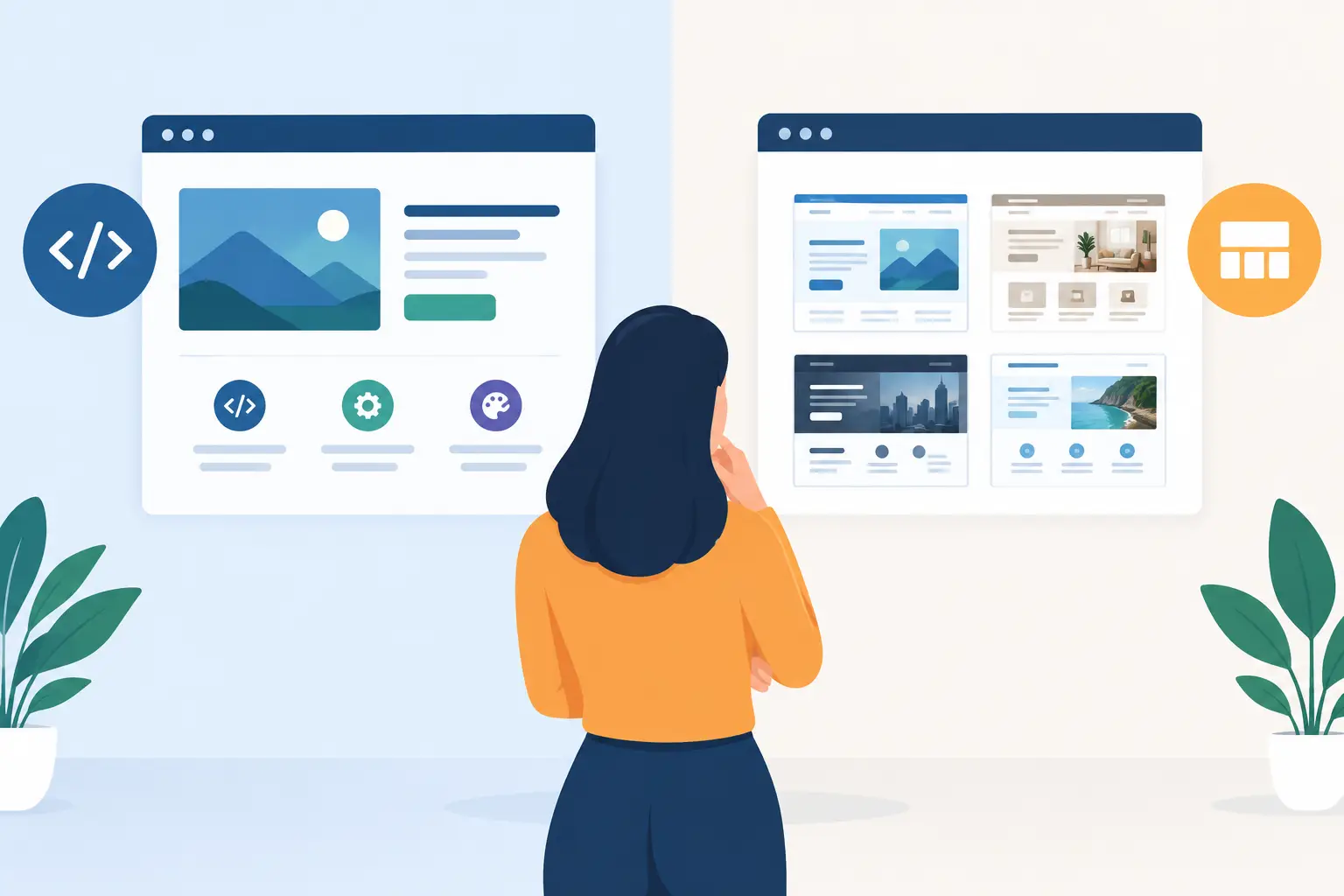
A prospective customer lands on your site, checks your services on their phone, and decides within seconds whether to get in touch. That moment is why the custom website or template decision matters. It is not simply a question of visual taste or upfront cost. It affects how easily your team can update content, how your enquiries flow into the business, and whether the site can support the next stage of growth.
A template can be the right answer. So can a bespoke build. The best choice depends on what the website needs to do, not on a blanket belief that custom is always better.
Custom website or template: the real difference
A template is a pre-built design and technical framework. You select a layout, replace the demo content, adjust fonts and colours, then publish it through a platform or content management system. It gives you a known structure and a fast route to a respectable marketing site.
A custom website is designed and developed around your specific brand, users and operational requirements. The page structure, interface, content model and integrations are chosen deliberately rather than shaped by the limits of a theme. It does not mean building every component from zero. Good custom development uses proven tools and sensible foundations, then applies them where they add value.
The gap between the two becomes clearer once a site has real work to do. A brochure site for a new local service business may need clear messaging, case studies and a contact form. A template can handle that well. A SaaS business that needs product-led landing pages, authenticated customer areas, Stripe billing, analytics events and support for regular campaigns is solving a different problem. That work benefits from a tailored system.
When a template is the sensible choice
Templates work best when the brief is focused, the content is straightforward and speed matters more than differentiation. If you need a clean five-page site with services, about, testimonials and contact details, a well-selected template can get you live quickly without spending budget on features you will not use.
They are also useful for testing a new offer. A founder validating a niche service may need a credible landing page, a simple lead capture route and enough analytics to see whether people respond. At this stage, the goal is learning, not building a large technical estate.
The key is to treat a template as a starting point, not a shortcut around decision-making. The copy still needs to speak clearly to the right customer. Images need to be considered. Mobile layouts, page speed, forms and consent settings still need checking before launch. A generic template with generic content rarely performs just because it looks polished in a demo.
There is another practical advantage: many common platforms make routine editing accessible. If someone in the business needs to change a paragraph, publish a news item or update opening hours, a straightforward template setup can be easier to maintain than an over-engineered build.
Where templates start to cost more
The initial price of a template is rarely the full cost. Businesses often choose one because it appears flexible, then spend months making it behave like something it was never designed to be.
Small changes can become awkward when the theme controls page structure, spacing, responsive behaviour or component styling. Extra plugins may solve individual problems, but each one adds another dependency to update, test and potentially troubleshoot. A site can gradually become slower and harder to manage as features accumulate.
Brand differentiation is another consideration. Templates are built to appeal to a broad market, which means their defaults often look familiar. That is not automatically a problem, but it can be limiting when your positioning depends on trust, specialist expertise or a more considered buying journey.
The larger issue is workflow. A template may be fine until a quote request needs to create a record in a CRM, notify the correct team member, trigger an automated follow-up and report where the lead came from. It may be fine until customers need to log in, manage a subscription, upload documents or view account-specific information. Those needs do not make a business unusually complex. They simply move the project beyond the shape of a standard marketing theme.
When a custom build pays for itself
A custom website earns its place when it removes friction for customers or staff. That could mean a service finder that guides visitors to the right option, a booking flow that prevents manual back-and-forth, or a customer portal that reduces repeated support requests.
It also pays off where the site is central to revenue. If paid traffic, search visibility, product sign-ups or partnership referrals all land on the website, the experience needs to support a measurable path from first visit to enquiry or purchase. Custom page sections, purposeful calls to action and accurate tracking make it easier to improve that path over time.
For digital products, custom is often the practical route rather than the premium route. A production-grade web app may need secure authentication, role-based access, a database, Stripe subscriptions, transactional emails and integrations with services such as Supabase or Google APIs. Trying to force that into a standard website template usually creates compromises in the wrong places.
A bespoke build also creates a cleaner foundation for future work. Instead of rebuilding the whole site when requirements change, you can add a new content type, dashboard view, integration or feature to an architecture designed with the product's direction in mind. Planning for likely change is different from building speculative features. The aim is flexibility with purpose.
Compare the cost over the next 12 months
It is tempting to compare a template licence with a custom project quote and stop there. A better comparison looks at the next year of ownership.
Consider how much time your team will spend updating the site, fixing workarounds and handling leads that should have been routed automatically. Consider the cost of a slow page that wastes paid advertising spend, or a confusing form that loses high-value enquiries. Consider whether a redesign will be needed in six months because the original setup cannot support your next offer.
A template usually has a lower entry cost and a shorter path to launch. A custom build has a higher initial investment, but can reduce operational effort and support stronger conversion when the requirements are clear. Neither outcome is guaranteed. The value comes from matching the build to a genuine business need.
For many businesses, the sensible middle ground is a lean custom marketing site. This is not an oversized web application. It is a fast, on-brand site with a tailored design system, carefully structured pages, reliable forms, analytics and room for future integrations. It avoids both extremes: a restrictive off-the-shelf theme and a needlessly elaborate build.
Start with the job your website must do
Before choosing a platform or design direction, define the result you need from the site. A good brief answers practical questions: Who is the primary visitor? What action should they take? What information do they need before they are ready? What happens after they submit a form, book a call or make a payment?
It should also identify internal requirements. If the team needs to update pages regularly, that matters. If leads need to reach different people depending on location or service, that matters. If the site must connect to existing systems, those integrations should be considered before design begins, not added as an afterthought.
This is where an end-to-end partner can save time. Design, development, deployment and go-live support are connected decisions. A polished interface is only useful if it loads well, works on real devices, captures data safely and gives the business a manageable process after launch.
A practical route for growing businesses
If your requirements are still forming, do not assume you must choose between a cheap template and a full custom platform. Start by building the parts that create the most immediate value. That may be a focused marketing site, clear service pages and a properly configured enquiry flow. Once the offer is proven, you can add a portal, automation, booking logic or subscription functionality with evidence behind the investment.
If the website is already creating operational headaches, the opposite may be true. Repeated manual tasks, inconsistent customer data and a growing pile of plugins are useful signals that a more purposeful build is overdue. The question is not whether a custom site sounds impressive. It is whether the current setup is slowing down work your business needs to do well.
Choose the option that gives customers a clear route forward and gives your team less to chase, patch and explain. A website should feel like a useful part of the business from the day it goes live, not another system waiting to be worked around.